Say how you made it.
Every track arrives with its own account: what you started from, who played on it, which tools you reached for. It is a credit list, not a confession. Nobody is penalised for how they work.

The home of transparently made music in the AI era
Put your track in front of people who actually listen. No names, no artwork, no follower counts: artists rank each other blind. The record that finishes on top gets cut to vinyl, and the artist keeps every penny it earns.
Season One is open and the room is still small. Free to enter, any genre, any method.
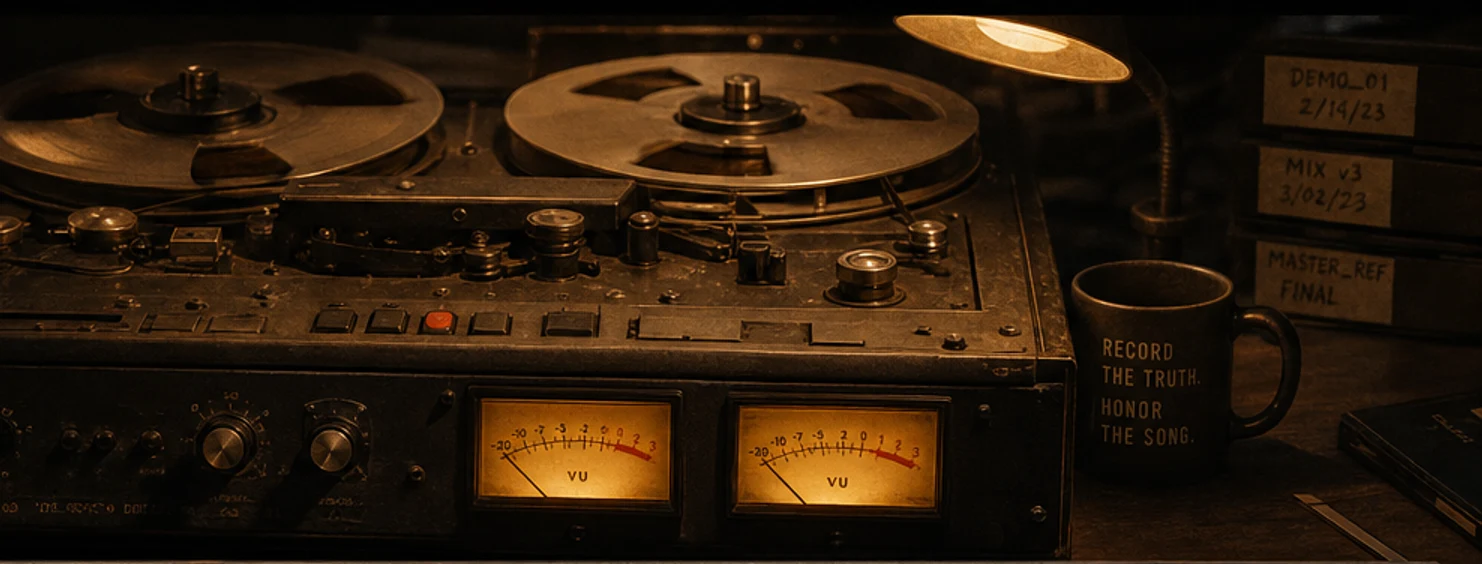
A tape machine transforms into a warm digital signal map, representing the path from original recording to an AI-era release.
Already in Season One
Press play, then switch between the two versions. This is the page every artist here gets, and the one your track would get. Pick either song below.
Demo and final, aligned
Joe Benso
0:00 / 2:14
1 Press play.2 Switch between Demo and Final to hear what changed.
You are hearing the final. Switch whenever you like.
Open the full Release Story, with receipts →
Both filings here are the founder’s own. Somebody had to go first, and asking artists to show their work while showing none of ours was never going to fly. The next names on this page are the ones who get in early.
How SoundLouder works
Fully human or AI-heavy, every track competes the same way: file the story of how it was made, stand in blind peer review, and let the season decide.
Every track arrives with its own account: what you started from, who played on it, which tools you reached for. It is a credit list, not a confession. Nobody is penalised for how they work.
Names off, artwork off, follower counts nowhere near it. Artists in the season hear each other in anonymous pairs and pick. The only thing that travels is the music.
Limited, numbered, on vinyl. You get a copy free, you keep 100 percent of whatever it sells for, and you can order another run whenever you want one.
What you get
Built with you, from two versions of one song. Listeners get something worth playing twice. You keep the deeper sources, credits, and permissions close without putting a technical dossier in front of anyone.
Bring two versions
Say how it happened
Get a page worth sending
Stand in front of blind ears
Chase the pressing
The liner noteTwo or three sentences on what stayed and what changed. Written by you, printed as you wrote it. We do not put words in your mouth here.
Your process, in your words
SoundLouder starts with whatever only you could bring: the melody, lyric, performance, or first recording. Then it shows where tools helped and who else shaped the release.
Not an example. These are the real fields from the filing above, measured from the two files, except the tool, which the artist named.
Your source notes, public excerpt, contribution roles, collaborators, permissions, tool use, and approval state. It is a clear release file, not a copyright certificate or a mystery score.
How a season runs
Free, open to anyone, about five minutes. Any genre, any method, any stage of a career.
Both versions, your account of the work, your credits. You approve every word before a stranger sees it.
Every entry meets the others in anonymous pairs. You listen too, and that is not a chore we bolted on: peer ears are the only thing ranking this chart.
Ranked by blind preference alone. Receipts visible, so anyone can see how the records at the top were made.
Top of the chart is cut to vinyl, numbered and limited. Free copy to the artist, all sales to the artist, repressed whenever they want more.
Season One is open
Every season starts with a handful of people who took the chance before there was any proof it would work. Those are the records the chart is built on, and the ones everyone else hears first. Right now that list is short enough to read in a breath.
Membership is $49 a year and adds unlimited tracks, priority in the listening queue, your disclosure pack, and how you scored across the axes. It buys convenience, never position. The chart, the feedback, and the pressing stay free for everyone.
Before you send anything
Entering is free and stays free. Your page, your place on the chart, and your shot at the pressing are not behind a paywall and never will be. Membership is $49 a year and adds unlimited tracks, priority in the listening queue, your disclosure pack, and how your track scored across the axes. Nothing about winning is for sale.
Two ways, both of them out in the open. Memberships at $49 a year, and manufacturing the records. We press and ship the vinyl and earn a margin on the run itself, which is exactly why the artist can keep every penny of the sales. If we ever add a third, it will be on this page before it is on your statement.
Anyone with original music and two versions of it. Fully human, AI-assisted, and AI-heavy are treated the same way. There is no jury deciding whether you are good enough to be here. The chart decides, and the chart is your peers.
A limited, numbered vinyl pressing. A copy of it, free. One hundred percent of whatever it sells for, wherever it sells. The masters and every right you walked in with. And the option to order another run through us any time, at cost plus the manufacturing margin.
Entries meet in anonymous pairs: names and artwork stripped, one forced preference, short written feedback. Social votes and follower counts never touch the chart. Everyone who enters also listens, which is what keeps it honest. The full rules, including how the founder participates, are on the methods page.
By default yes, because the comparison only means anything if both versions run. That is a real decision to make with your eyes open: your rough version becomes public. If you would rather publish a shorter section, say so and we will cut it to wherever you choose before anything goes live.
They are read from your two files, not from anything you or we assert. Runtime, tempo, channels, frequency range, loudness, dynamic range. Both versions are re-encoded identically first, so nothing a listener hears is an artifact of one file being a better copy than the other. Where two versions line up closely enough, we can also mark which passages exist in one and not the other. That depends on the music, and it is not promised for every track.
No. People hear the song first, and where it started. Tools are described by the role they played, alongside writing, performance, production, and the humans involved. The point was never to flag anyone.
By hand, and deliberately. You send the files, a person builds the page, and you approve it. Self-serve comes when hand-building starts to hurt. Asking artists to show their work while being vague about our own was never an option.
Both versions are already on your drive. Season One is open, entering is free, and the record at the top of the chart gets cut to vinyl.
Submit your track